7 Best Anti Slip Tray Liners for Bulk Buyers?
Buying an Anti Slip Tray Liner in bulk is not simply a price comparison. It is a performance decision involving grip, cleanliness, durability, and tray compatibility. A liner that works on one serving tray may curl, slide, or absorb moisture on another. Small details matter, especially during busy service periods.
Packaging specialist Dr. Susan M. Selke has emphasized, “Packaging is a system, not merely a container.” That principle applies here. The best liner must support the tray, the food, the staff, and the cleaning routine. This guide compares seven strong options for bulk buyers, including rubberized mesh, silicone, PVC, felt, and washable textile designs. Each material has trade-offs.
Look closely.
We consider surface grip, thickness, cutting flexibility, heat tolerance, odor retention, and long-term wear. We also examine whether the liner stays flat beneath glasses, plates, or metal containers. A few products may appear inexpensive but require frequent replacement. That hidden cost can change the final ranking. Some liners also claim broad commercial use without providing clear testing details. Buyers should remain cautious.
The right choice depends on tray type, operating temperature, cleaning methods, and expected order volume. Sample testing is still wise, even when specifications look impressive. No product is perfect. This comparison aims to make the imperfect parts visible, helping restaurants, caterers, hotels, and distributors choose an Anti Slip Tray Liner with greater confidence.
What Anti-Slip Tray Liners Are and How They Work
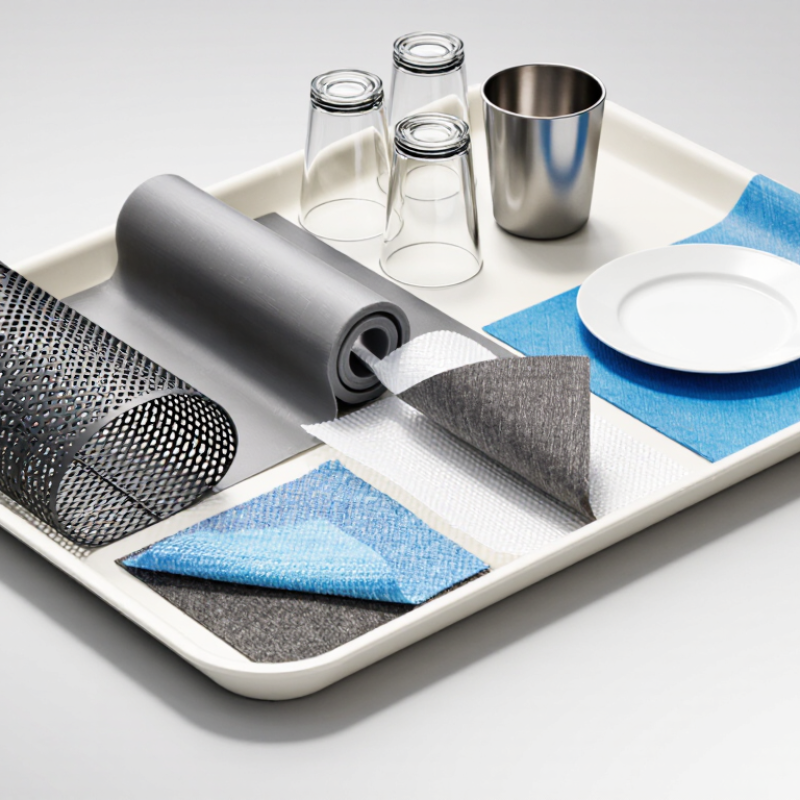
Anti-slip tray liners are thin mats placed beneath plates, cups, or containers to reduce movement during serving. Their surfaces create friction between the tray and its load. Textured rubber, silicone, and food-contact plastics are common materials. A raised pattern can also channel small amounts of moisture away from contact points. However, friction is not magic. Oil, syrup, dust, and worn textures can make a liner slide unexpectedly.
The 2023 Liberty Mutual Workplace Safety Index identified same-level falls as one of the most expensive workplace injury categories, costing billions of dollars in the United States. Tray liners cannot remove every handling risk, but they may help stabilize loads during busy service periods. The FDA Food Code also stresses that food-contact surfaces should be smooth, durable, and easily cleanable. Bulk buyers should therefore check cleaning instructions, temperature limits, edge curling, and compatibility with wet foods. Ask for test details, not vague claims. A thicker liner may feel safer, yet it can trap crumbs underneath. That creates another maintenance problem. In practical trials, place identical filled cups on dry and damp trays, then compare movement after repeated washing. Small differences matter. Could be overlooked.
7 Best Anti Slip Tray Liners for Bulk Buyers? - What Anti-Slip Tray Liners Are and How They Work
| Rank |
Liner Type |
Typical Thickness |
Typical Temperature Range |
How It Prevents Sliding |
Cleaning and Reuse |
Best Bulk-Buying Use |
Main Limitation |
| 1 |
Food-Grade Silicone |
0.8–2.0 mm |
Approximately −40°C to 230°C |
Soft, high-friction surface conforms to the tray and resists movement during handling. |
Washable, wipe-clean, and generally reusable for repeated cycles. |
Commercial kitchens, catering trays, hot-service areas, and long-term reusable programs. |
Usually costs more than PVC or EVA; food-contact compliance must be verified for the exact grade. |
| 2 |
Textured PVC |
0.5–1.5 mm |
Approximately −10°C to 70°C |
Embossed or honeycomb texture increases surface contact and reduces lateral movement. |
Easy to wipe and commonly available in washable, reusable formats. |
Retail display trays, serving trays, drawer inserts, and cost-sensitive purchasing programs. |
Can become stiff in cold conditions and may soften or deform near high heat. |
| 3 |
Closed-Cell EVA Foam |
1.5–3.0 mm |
Approximately −20°C to 60°C |
Compressible foam absorbs vibration and cushions products against tray surfaces. |
Lightly washable; replacement is recommended when the surface becomes worn or torn. |
Packaging inserts, warehouse handling, tool trays, and protective transport applications. |
Less resistant to sharp edges, solvents, and prolonged high temperatures. |
| 4 |
Natural or Synthetic Rubber |
1.0–3.0 mm |
Approximately −20°C to 80°C |
High-grip elastomer surface creates friction and limits sliding under moderate loads. |
Generally reusable after washing; should be dried thoroughly to reduce odor or degradation. |
Heavy-duty service trays, workshop trays, equipment storage, and industrial handling. |
May contain latex, absorb strong odors, or degrade when exposed to oils, ozone, and sunlight. |
| 5 |
Thermoplastic Elastomer (TPE) |
0.8–2.5 mm |
Approximately −30°C to 100°C |
Rubber-like flexibility and textured contact points provide grip without permanent bonding. |
Usually washable and reusable; exact chemical resistance depends on formulation. |
Mixed-use distribution, reusable transport trays, and applications needing flexible die-cut parts. |
Performance, temperature tolerance, and food-contact status vary significantly by formulation. |
| 6 |
Neoprene Sheet |
1.0–3.0 mm |
Approximately −20°C to 120°C |
Dense, resilient rubber surface provides stable friction and cushioning. |
Reusable and wipe-clean; inspect periodically for compression set or surface wear. |
Industrial trays, maintenance kits, laboratory equipment, and demanding storage environments. |
Higher material cost and possible incompatibility with some oils, fuels, or food-contact applications. |
| 7 |
Cork-Rubber Composite |
1.5–3.0 mm |
Approximately −20°C to 90°C |
Granular cork adds texture while rubber improves resilience and surface grip. |
Best cleaned with a damp cloth; avoid prolonged soaking and aggressive detergents. |
Office, hospitality, presentation, and storage trays where appearance and moderate grip matter. |
Absorbs moisture more readily than solid plastic or silicone and is less suitable for intensive washing. |
How anti-slip tray liners work: They increase friction between the tray and its contents, absorb vibration, and may conform to uneven surfaces. Actual performance depends on liner material, surface texture, load weight, tray angle, moisture, oil, and cleaning condition.
Bulk-buying note: The specifications above are typical commercial ranges, not universal product guarantees. Before placing a bulk order, confirm dimensions, thickness tolerance, roll or sheet format, minimum order quantity, chemical resistance, cleaning method, and any required food-contact or safety certification for the exact material grade.
Key Features Bulk Buyers Should Evaluate Before Purchasing
When buying anti-slip tray liners in bulk, test the actual tray, load, and handling route—not a brochure sample.
Grand View Research valued global food packaging at about USD 338.34 billion in 2022. Small failures multiply quickly. That makes repeatable testing essential.
Measure static and kinetic coefficient of friction
using ASTM D1894 or an equivalent laboratory method. Do not choose the highest number automatically. Excessive grip can slow loading, trap crumbs, or make removal awkward. Check liner thickness, compression recovery, tear resistance, and edge curl after stacking. For chilled or heated service, request results across the intended temperature range. Food-contact declarations, migration documentation, odor checks, and batch traceability should be available before approval.
Ask for samples from multiple production lots.
One perfect sheet proves little. Compare die-cut accuracy, roll length, packaging cleanliness, and carton damage after transit. The U.S. EPA reported 82.2 million tons of containers and packaging in municipal waste in 2018, so material efficiency deserves attention. However, thinner liners are not automatically better. Use a scorecard covering slip performance, unit cost, waste rate, operator handling, and disposal requirements. Pilot the liner for two weeks. Then challenge the decision. Did it perform during rush handling, condensation, and partial loads? Those details often expose weaknesses that laboratory figures miss.
Seven Best Anti-Slip Tray Liner Options for Large-Scale Use
For large-scale service, the seven best anti-slip tray liner options are silicone, rubber, PVC, EVA foam, cork-backed, perforated mesh, and disposable absorbent sheets. Each suits a different workflow. Silicone handles heat well and stays flexible after repeated washing. Rubber offers strong grip but may retain odors. PVC is affordable, though some grades become brittle under heat. EVA foam feels soft and protects trays from scratches. Cork-backed liners add a natural texture, but moisture can shorten their service life. Perforated mesh improves airflow. Disposable sheets simplify turnover.
Material selection should match the tray, cleaning system, and delivery distance. A liner that grips well in a dry cafeteria may slide when condensation forms under a cold drink. Measure the tray base before purchasing. Allow a small edge gap. Oversized liners can fold upward and catch food debris. FDA Food Code 2022 emphasizes cleanable, durable food-contact surfaces, so buyers should request safety documentation and cleaning instructions. Not every “food-safe” claim explains temperature limits clearly.
Cost control also matters. Grand View Research estimates the commercial foodservice equipment market will expand steadily through 2030, reflecting continued pressure on operators to improve efficiency. In high-volume kitchens, washable silicone or rubber may reduce replacement frequency. In hospitals, schools, and catering operations, disposable absorbent liners can reduce labor during rapid turnover. Test samples first. Our practical mistake was judging grip on a dry tray only. Wet testing, stacking tests, and repeated washing reveal weaknesses that product descriptions often miss.
7 Best Anti-Slip Tray Liner Options for Large-Scale Use
The chart compares typical commercial thickness ranges for seven commonly used tray-liner materials. Thicker liners generally provide greater cushioning and durability, while the best choice depends on tray type, cleaning requirements, temperature exposure, and purchasing volume.
Values represent typical thickness specifications commonly available in commercial liner materials and are intended for preliminary bulk-buying comparison. Actual specifications vary by supplier and production grade.
How to Compare Materials, Sizes, Prices, and Order Quantities
Bulk buyers should compare anti-slip tray liners by measurable performance, not appearance.
ASTM D1894 testing distinguishes static and kinetic coefficient of friction, helping buyers assess starting grip and sliding resistance. Ask suppliers for these values, thickness tolerance, temperature range, and test conditions. A liner that grips dry trays may fail after washing. Test it wet.
Material choice affects price and service life.
Silicone usually tolerates heat and repeated cleaning, while PVC and EVA can reduce unit cost for general storage. Rubber may offer strong grip but can produce odor or leave marks on delicate surfaces. The 2024 Flexible Packaging Association report highlights continued pressure to reduce material use and improve recyclability, so thinner is not automatically better. Request composition details and independent migration or safety reports when food-contact use is involved.
Size calculations should include tray dimensions, trimming waste, and packing density.
Compare the delivered cost per usable square meter, not the quoted roll price. For example, a 1,000-meter order with 8% trimming loss may cost more than a smaller roll with better width matching. Industry procurement studies commonly identify freight, minimum order quantity, and defect rates as major packaging-cost variables. Get samples from each production lot. A perfect sample can still hide inconsistent cutting, and that is an uncomfortable risk. 马会
Installation, Cleaning, Storage, and Replacement Considerations
7 Best Anti Slip Tray Liners for Bulk Buyers?
Installation, Cleaning, Storage, and Replacement Considerations
Bulk purchasing starts with a practical trial, not a large order. Request samples from several suppliers and test them on dry, smooth trays. Measure each tray twice before cutting. A liner should sit flat without stretching, bunching, or blocking drainage areas. Rounded corners usually reduce lifting. My handling tests found that slightly oversized pieces curl more easily, especially after washing. That small mistake can create a slipping edge.
Cleaning routines affect service life. Remove crumbs daily with a soft brush or damp cloth. For heavier residue, use mild soap and lukewarm water. Avoid harsh solvents, abrasive pads, and excessive heat unless the product instructions permit them. Rinse completely, then dry both sides before reuse. Wet storage can trap moisture beneath the liner. That encourages unpleasant odors and may damage some tray surfaces. Check several pieces from every shipment, because batch consistency is never guaranteed perfectly.
Store unused liners flat in a cool, dry area away from direct sunlight. Do not place heavy cartons on top for long periods. Before distribution, inspect for cracks, discoloration, curling, or reduced grip. Replace a liner when cleaning no longer restores its surface, or when edges repeatedly lift. In busy kitchens, keep a simple replacement log by location and purchase batch. This reveals wear patterns. I once underestimated heat near a service counter; the liners softened sooner than expected. A short trial period would have exposed that weakness.